2026 THEME
The Future Speaks Afro-Creole
The future of Afro-Creole languages depends on the choices we make today. Every conversation, every story, every song, every classroom and every new speaker helps ensure these languages continue to thrive
This year's theme, The Future Speaks Afro-Creole, is a call to celebrate our shared linguistic heritage, pass our languages to the next generation, and recognise them as living African languages that continue to connect communities across the world.
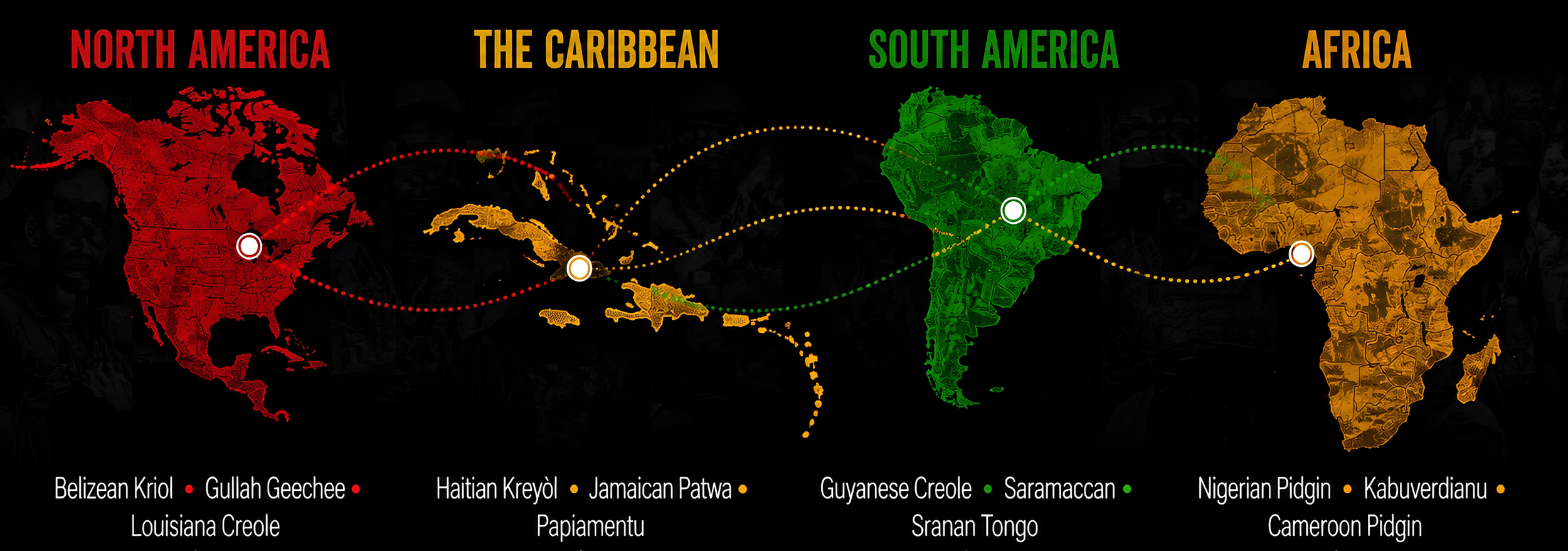
Afro-Creole Languages Week celebrates all Afro-Creole languages, including:
Haitian Kreyòl | Jamaican Patwa | Sierra Leonean Krio | Nigerian Pidgin | Trinidadian English Creole | Gullah Geechee| Papiamentu | Kabuverdianu | Antillean Creole (Kwéyòl) | Gullah Geechee | Sranan Tongo | Saramaccan | São Tomense | Kreol Morisien (Mauritian Creole) | Kreol Rodrige (Rodriguan Creole) | Kreol Seselwa (Seychellois Creole) | Kréol Réyoné (Réunion Creole) | Belizean Kriol | Bahamian Creole | Bajan (Barbadian Creole) | Guyanese Creole | Cameroon Pidgin English | Kolloqua | Cape Verde Creole | Nubi | Sango | Kituba | Salone Krio| Kamtok | Lousianna Creole
And many others spoken by communities of African descent across the world.
They are not simplified versions of European languages. They are complete, rule-governed, expressive linguistic systems with their own grammars, literatures, oral traditions, and intellectual capacities.
Over half a century of Caribbean linguistics has established this beyond serious dispute. The work of the Society for Caribbean Linguistics, the International Centre for Caribbean Language Research, and the Jamaican Language Unit at the University of the West Indies has documented the full complexity of these languages and advocated for their recognition in education, governance, and public life.
Afro-Creole languages carry African philosophies of time, kinship, causality, healing, justice, and governance in their grammars, vocabularies, proverbs, and ceremonial speech.
They encode knowledge systems that originate in Igbo, Yoruba, Fon, Akan, Kikongo, Wolof, Mende, Mandinka, and many other African linguistic traditions. These systems did not disappear on the Middle Passage. They were reconstituted, adapted, and transmitted through the languages that enslaved Africans created under conditions that were engineered to eradicate African thought. The languages survived. The knowledge they carry is still operating.